
Installations & Replacements After Water and Fire Damage
When water, sewage, fire or long-term moisture ruins a material, it is removed, the space behind it is dried, and new material goes in. We rebuild the walls, floors and ceilings that had to come out.
Porous Materials Hold On to What Soaked Into Them
Restoration starts from the idea that whatever can be dried and cleaned should stay. Some materials cannot be brought back, though. Drywall, insulation, carpet padding and particleboard are porous: they take in water like a sponge, and with it whatever the water carried.
Clean water from a burst supply line carries little with it. A sewage backup carries bacteria into every fiber it reaches. Smoke settles on hard surfaces, where it can usually be cleaned, and works into soft ones, where it often cannot. A slow leak that ran for weeks gives mold time to grow inside a wall, so the material has often broken down by the time the wall is opened.
A replacement usually comes down to one of three things: contamination that cleaning cannot reach, a material that has lost its strength or shape, or mold that has grown into it.
The Materials That Usually Go, and What Replaces Them
Each material has its own reasons for coming out and its own way back in.
| Material | Why it is usually replaced | What goes in |
|---|---|---|
| Drywall | Soaked by sewage, swollen, crumbling or moldy; drywall wet with clean water is often dried instead | New board cut in along a straight line, then taped, finished and painted |
| Insulation | Batts hold water against the framing, slump in the cavity and lose the loft that makes them insulate | New insulation of the same kind and thickness once the cavity reads dry |
| Carpet and padding | Padding holds water and is hard to dry all the way through; carpet touched by sewage goes as well | New padding, and new carpet where the old could not be saved |
| Hardwood and laminate flooring | Laminate and engineered boards swell at the core; solid hardwood goes when it stays cupped or was soaked by sewage | New boards laced into the old floor, or a new floor across the room |
| Baseboards and trim | MDF swells and splits once wet, and trim soaked by sewage cannot be cleaned through | New baseboard and casing, primed, caulked and painted |
| Cabinets | Particleboard boxes swell and come apart, and a cabinet floor under a slow leak often grows mold | New cabinets, once the wall and floor behind them are rebuilt and dry |
| Ceiling tiles | Mineral fiber tiles stain and sag once wet, and the stain seldom cleans out | New tiles in the existing grid once the source above is stopped and dried |
Repair or Replace, Material by Material
Choose a material and the cause of the damage for a general first answer: usually repaired, usually replaced, or worth a closer look before anyone decides.
Choose a material and the cause of the damage, then press the button.
A Flood Cut Opens the Wall to Let the Cavity Dry

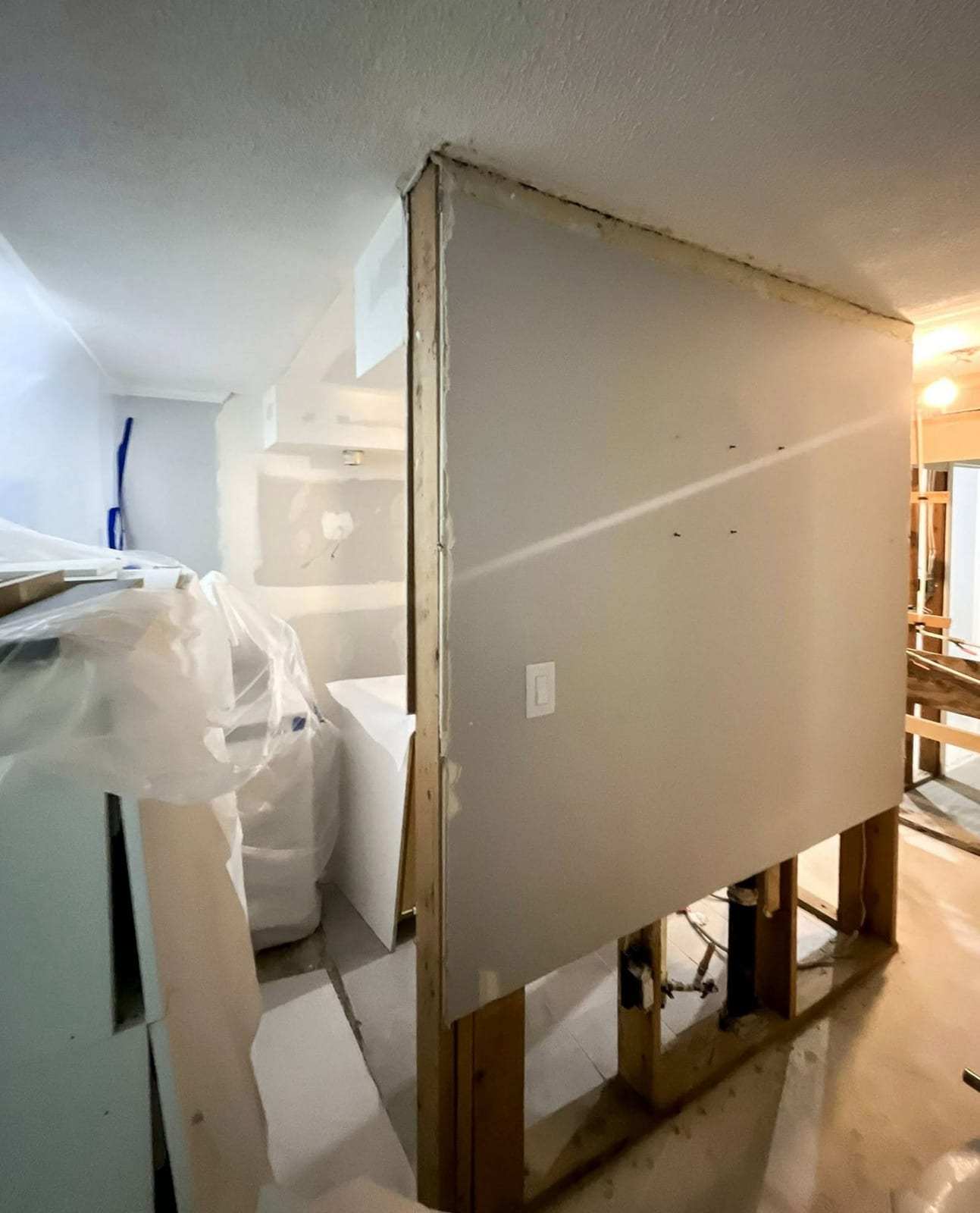
When water gets inside a wall, the drywall is usually cut along a straight line above the highest wet reading. The trade calls it a “flood cut.” It opens the cavity so air can reach the studs and the back of the board that stays.
Behind the drywall, fiberglass batts are often the wettest thing in the wall. They hold water against the framing, slump to the bottom of the cavity and, after a sewage backup, carry contamination that no cleaning reaches. A pipe that froze and split inside an exterior wall during a Chicago winter often leaves exactly this behind.
We take out the wet insulation along with the cut drywall. New insulation goes in once the studs read dry, and the new drywall is hung along the cut line so the seam can be taped and finished cleanly.
Replacing Wet Insulation and Carpet Padding
Why is wet insulation replaced instead of dried?
Fiberglass batts trap water deep in the fibers, grow heavy and slump, so they lose the loft that makes them insulate. Left in a closed wall, they also hold moisture against the studs and slow the drying of the whole cavity. Taking them out lets the framing dry.
Why does the padding usually go even when the carpet can stay?
Padding is made to hold air, and it holds water the same way, often wicking it out toward the edges of the room. It is hard to dry all the way through and easy to leave damp underneath. With clean water caught early, the carpet itself can sometimes be dried and laid again over new padding.
Does insulation have to come out after a sewage backup?
Yes, wherever the sewage reached it. Insulation that soaked up Category 3 water cannot be cleaned, so it comes out with the drywall, carpet and padding it touched, and the framing is cleaned and dried before anything new goes in.
What goes back in place of the insulation that came out?
Insulation that does the same job: the same kind and thickness for the cavity and, in an exterior wall, an insulating value that matches the rest of the wall. It goes in just before the new drywall.
Ceilings Cut Back to the Joists After a Leak Above

Water from a leak above settles on the back of the ceiling drywall and soaks whatever insulation lies over it. When a ceiling sags or a stain keeps spreading, the wet section is usually cut out back to the joists, so the insulation can come down and the space can dry from below.
Stained insulation in the opened bays shows how far the water spread before it came through. The opening is squared off at dry, firm board, which gives the new drywall a solid edge to meet and keeps the patch from following the shape of the stain.
Bulkheads Opened to Reach Water Around the Ducts

Bulkheads and soffits box in ducts and pipes, and water that reaches them can run along a duct or a pipe and collect out of sight. Opening a bulkhead down to its framing is often the only way to reach the wet insulation inside and dry the space around the ductwork.
Once the readings say the framing is dry, the bulkhead is closed in again with new drywall, taped and finished to meet the old surfaces, and painted with the rest of the room.
Points to Settle Before Anything Is Replaced
A replacement plan rests on a few plain facts, and most of them are things a property owner already knows.
- Which rooms the damage reached
- How long the material stayed wet: hours, days or weeks
- Whether the damage is in a floor, a wall or a ceiling
- What the water was: a supply line, a drain or sewer backup, rain from outside or water used to put out a fire
- What the material is, if you know: drywall or plaster, carpet or hardwood, MDF or solid wood trim
- Whether a musty smell or visible mold has shown up
- Whether the leak or the source of the damage has been stopped
Call with the material and what wet it, and we will talk through what can stay and what has to go.